
Watering Without Waste
How much, how often, and how to tell
 admin
3 min read
admin
3 min read
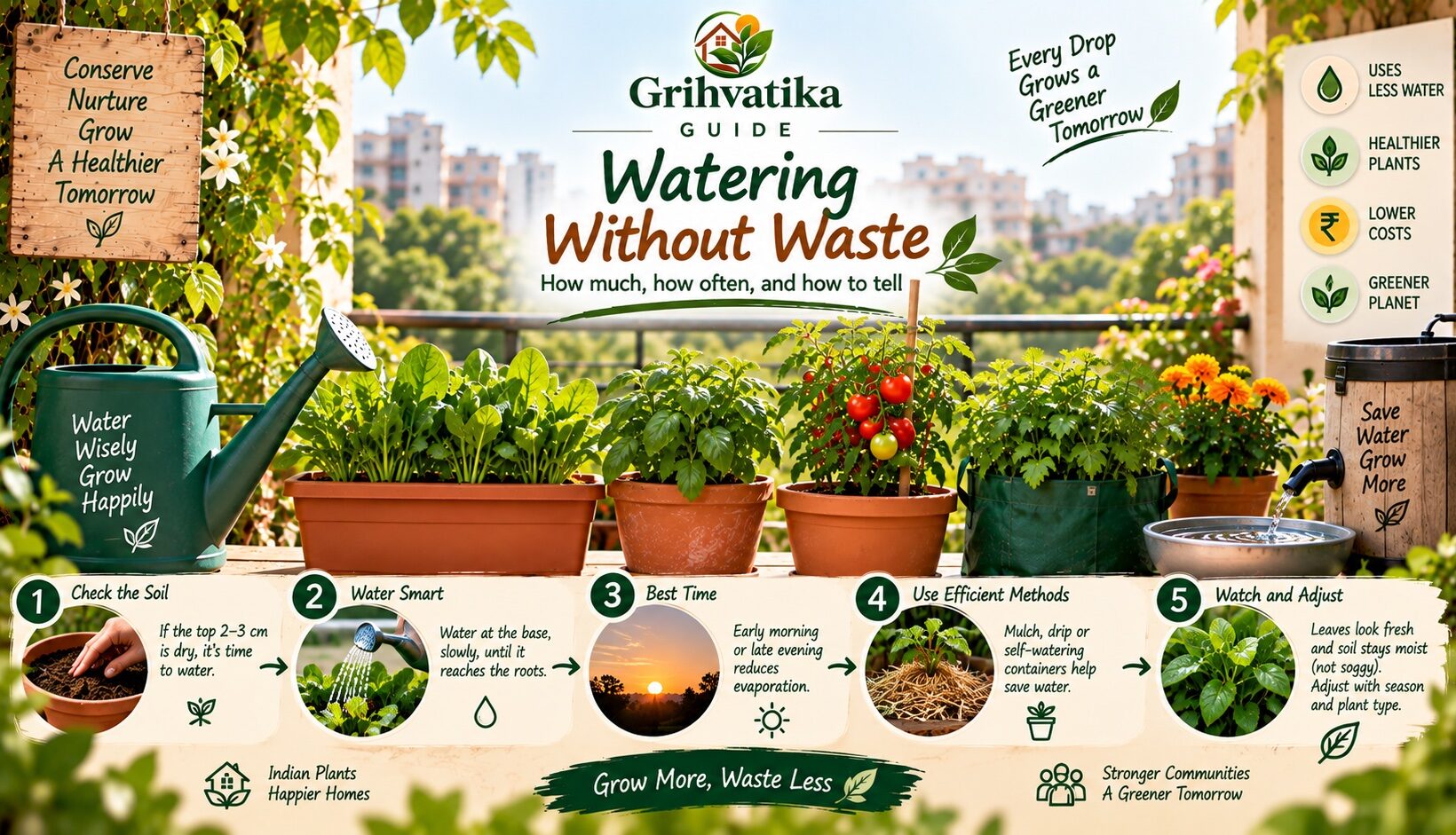
What you get: a way to decide whether to water that is right about nine times in ten — which matters, because incorrect watering kills more Indian container plants than pests and disease together.
Check the soil, not the calendar
Push a finger 3 to 5 cm into the soil, near the pot edge rather than against the stem.
- Soil sticks to your finger, feels cool — do not water.
- Dry and crumbly at that depth — water now, thoroughly.
- Wet and heavy, and it was wet yesterday too — stop watering and check the drainage holes.
Lifting the pot works just as well once you have the feel of it: a pot that needs water is noticeably lighter. A cheap bamboo skewer pushed in and pulled out tells you the same thing at depth.
Why drooping is not the signal to water
A wilting plant may be too dry or drowning — roots suffocated by waterlogged soil cannot take water up, so the leaves droop exactly as they do in drought. Reaching for the mug at that point finishes the plant off. Always check the soil first. Some plants also wilt at 2 pm in May and recover by evening on their own; that is heat, not thirst.
Water properly, then leave it alone
Water slowly until it runs out of the drainage holes, then stop. That wets the whole root ball and washes accumulated salts out. A daily splash that dampens the top 2 cm trains roots to stay at the surface, where they cook on a hot day.
- Water the soil, not the leaves. Wet foliage overnight is how fungal disease starts.
- Morning is best — the plant uses the water through the day and the leaves dry before dark. Early evening is acceptable in peak summer.
- Never water in full midday sun in summer: most of it evaporates and the shock is real.
- If water runs straight through in seconds, the mix has dried and shrunk from the sides. Stand the pot in a bucket for 20 minutes to rewet it fully.
Roughly how often
Use this as a starting point, then correct it with the finger test.
- Summer (Apr–Jun), balcony: shallow troughs daily, sometimes twice; deep pots every second day.
- Monsoon (Jul–Sep): often not at all. Check for waterlogging instead — this is when most drowning happens.
- Post-monsoon (Oct–Nov): every second day.
- Winter (Dec–Feb): every second to fourth day. Growth is slow and water use drops sharply.
- Succulents and aloe: once a fortnight in summer, once a month in winter.
- Seed trays: mist the surface daily until germination, then move to the finger test.
Using less
- Mulch. Two centimetres of dry leaves, coco husk or straw on every pot cuts evaporation by around a third and keeps roots cool.
- Group by thirst, and stand thirsty pots on a shared tray.
- Reuse household water: water from washing rice, dal or vegetables is fine and mildly nutritious. Water with soap, detergent, salt or oil in it is not.
- Bottle drip: a 2-litre bottle with two pinholes in the cap, inverted into the soil, waters a large pot for two to three days.
- Catch the monsoon. Even a bucket under a downpipe stores enough to see a balcony through a dry week, and rainwater is better for plants than hard tap water.
Hard water, and what to do about it
Much of India has hard or saline tap water. Over months it leaves a white crust on the soil surface and pot rim, and leaf tips brown. Flush each pot thoroughly with a large volume of water once a month so salts drain away, scrape off the crust, and use stored rainwater for sensitive plants — ferns, orchids and blueberries especially.
Reading the leaves
- Lower leaves yellow, soil damp — overwatering.
- Whole plant crisp, soil dry, pot light — underwatering.
- Brown crispy leaf tips only — salt build-up, hard water, or dry air.
- Yellow leaves with green veins — nutrient lock-out, usually from constantly wet soil.
- Soft blackening stem at soil level — root rot. Repot immediately into fresh dry mix and cut off any brown mushy roots.
- Sour smell from the soil — anaerobic and waterlogged. Repot; that plant will not recover in situ.
- Review
- Not yet reviewed by a named specialist
- प्रकाशित