
Seeds, Cuttings and Free Plants
Save your own seed and root what the kitchen throws out
 admin
5 min read
admin
5 min read
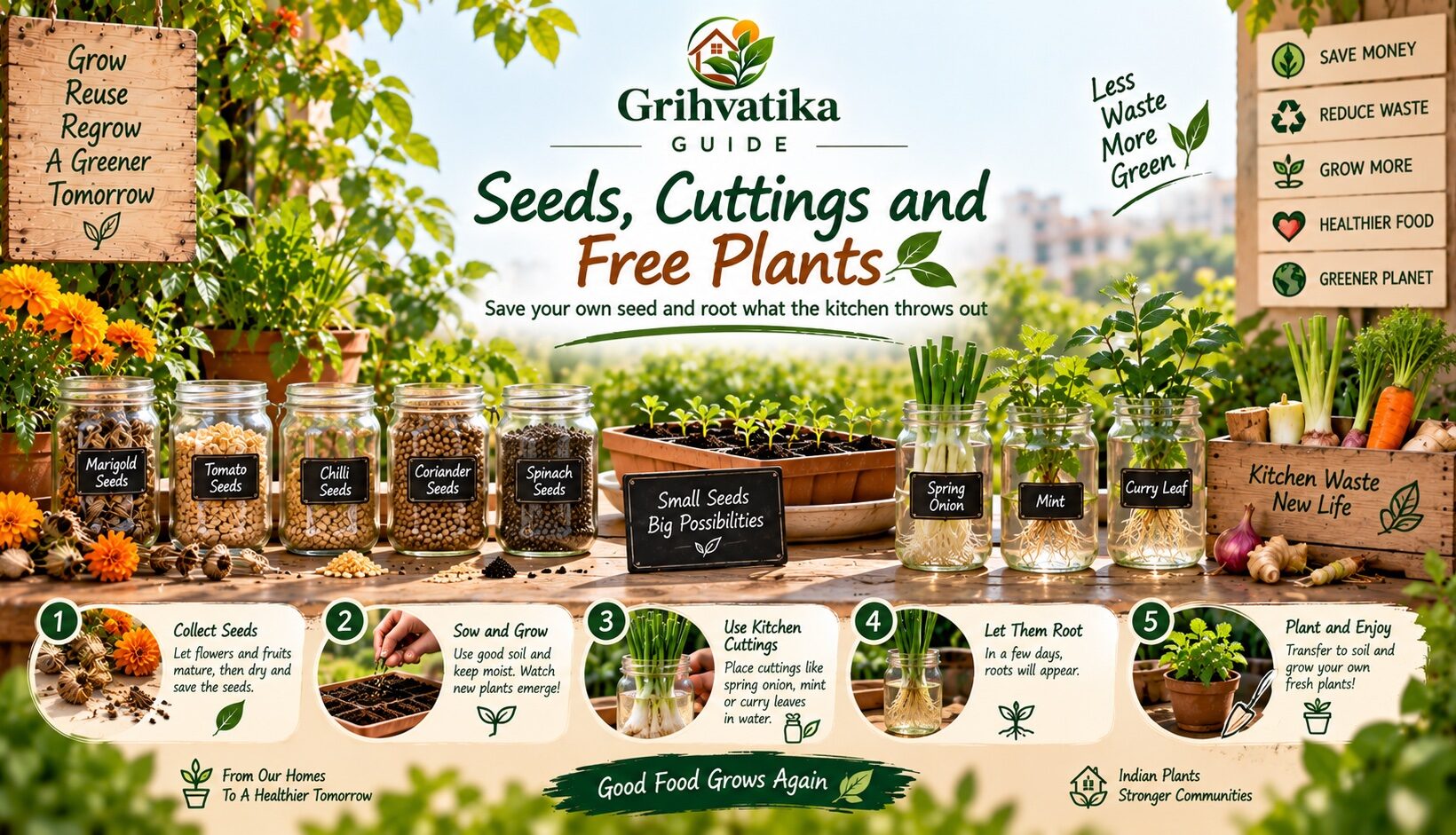
What you get: most of next season’s planting for nothing — from seed you saved, cuttings you rooted, and the root ends of vegetables already in the kitchen.
Saving seed that will actually grow
Let the plant complete its life. Seed taken green will not germinate.
- Coriander, methi, fennel, ajwain: leave two or three plants to flower and dry on the stem. Cut the whole head when it is brown and brittle, rub it out over a newspaper, and winnow the chaff away in a light breeze.
- Chilli and tomato: take seed from a fully ripe fruit — deep red, slightly soft. For tomato, ferment the pulp in a little water for three days, stirring daily, then wash the seed clean; that removes the germination-inhibiting coat.
- Okra and beans: leave a few pods to go papery and rattle on the plant. Shell them once fully dry.
- Marigold: pick the whole dry brown flower head; the black-and-white spikes inside are the seed.
Drying and storing: spread seed in shade for three to five days until a seed snaps rather than bends. Store in a labelled paper envelope or an airtight jar with a spoon of dry rice as a desiccant, kept cool and dark. Label with the name and the month — you will not remember. Most vegetable seed stays viable two to three years; onion and coriander decline faster.
Two cautions. Seed saved from an F1 hybrid will not come true — the seedlings vary wildly. Save from open-pollinated and desi varieties instead. And pumpkins, gourds and cucumbers cross with each other readily, so seed from a mixed balcony can give you something unexpected.
Testing old seed in five days
Fold ten seeds into a damp cloth, keep it in a covered box somewhere warm, and count how many have sprouted after five days. Seven or more: sow normally. Three to six: sow twice as thickly. Fewer than three: compost it and buy fresh.
Cuttings — free plants from what you already have
Softwood cuttings in water — the easiest way to begin
Works for mint, ajwain leaf, money plant, coleus, basil and tulsi. Cut a 10 cm piece of healthy non-flowering stem just below a node, strip the lower leaves, and stand it in a glass of water on a bright sill out of direct sun. Change the water every second day. Roots appear in 7 to 14 days; pot up once they are 3 cm long, and keep the new plant shaded and damp for a week.
Cuttings in soil — for woody plants
Works for hibiscus, bougainvillea, curry leaf, rose, jasmine, ixora and champa. Take a pencil-thick, 15 to 20 cm cutting during the monsoon, when the humidity does the work for you.
- Cut the base at a slant just below a node; cut the top flat, above a node.
- Remove all but the top two leaves, and halve those to cut water loss.
- Dip the base in honey or cinnamon powder — both are mild natural antifungals — or in rooting hormone if you have it.
- Push it a third of its length into a small pot of coco peat and sand, firm it in, and water.
- Cover with a cut plastic bottle to hold humidity, and keep it in bright shade. Never in direct sun.
- Water lightly every second day. A gentle tug after three to six weeks tells you whether it has rooted.
Hardwood cuttings — the easiest of all
Champa (plumeria), moringa, coral tree, karonda and fig root from a thick leafless cutting pushed straight into the ground at the start of the monsoon. Let a champa cutting dry in shade for a week before planting, or it rots.
Regrow from the kitchen
- Spring onion: keep 3 cm of the root end, stand it in 2 cm of water for a week, then pot it. Cuttable in three weeks, repeatedly.
- Coriander root: a root with 2 cm of stem, potted in damp mix, will re-leaf.
- Ginger and turmeric: a market knob with visible growing eyes, planted 5 cm deep in a wide pot in May or June. Harvest after eight months.
- Garlic: a sprouted clove planted pointed end up gives garlic greens in three weeks — excellent in a dal even if no bulb forms.
- Lemongrass: a stalk with the base intact, stood in water for ten days, roots and becomes a clump.
- Potato: a sprouted potato cut so each piece has two eyes, planted 10 cm deep in a deep bag or bucket, with soil mounded up as it grows.
- Pineapple: twist the crown off, strip the lowest leaves, dry it for a day, then pot it. It roots readily and looks good long before it fruits.
Sowing what you saved
- Sowing depth: about twice the seed’s own thickness. Fine seed such as amaranth is barely covered; a bean goes 3 cm deep.
- Hard-coated seed (amaltas, kachnar, lotus) needs help: soak 12 to 24 hours in water, or nick the coat carefully with a nail clipper.
- Direct-sow root crops, coriander, methi and gourds where they will grow; they resent transplanting.
- Raise in trays and transplant tomato, chilli, brinjal, cabbage and marigold, at the four-leaf stage, in the evening, watered in immediately.
- Sow thinly and thin ruthlessly. Crowded seedlings damp off and never recover.
Share what you have raised
Every rooted cutting and full seed envelope is a plant somebody else does not have to buy. Seed swaps between neighbours also keep local varieties alive — the desi chilli or the lauki that has grown on your street for decades exists because households kept passing it on, and no seed company sells it.
- Review
- Not yet reviewed by a named specialist
- Published