
How to Start a Kitchen Garden
Three containers, four weeks, food on the table
 admin
5 min read
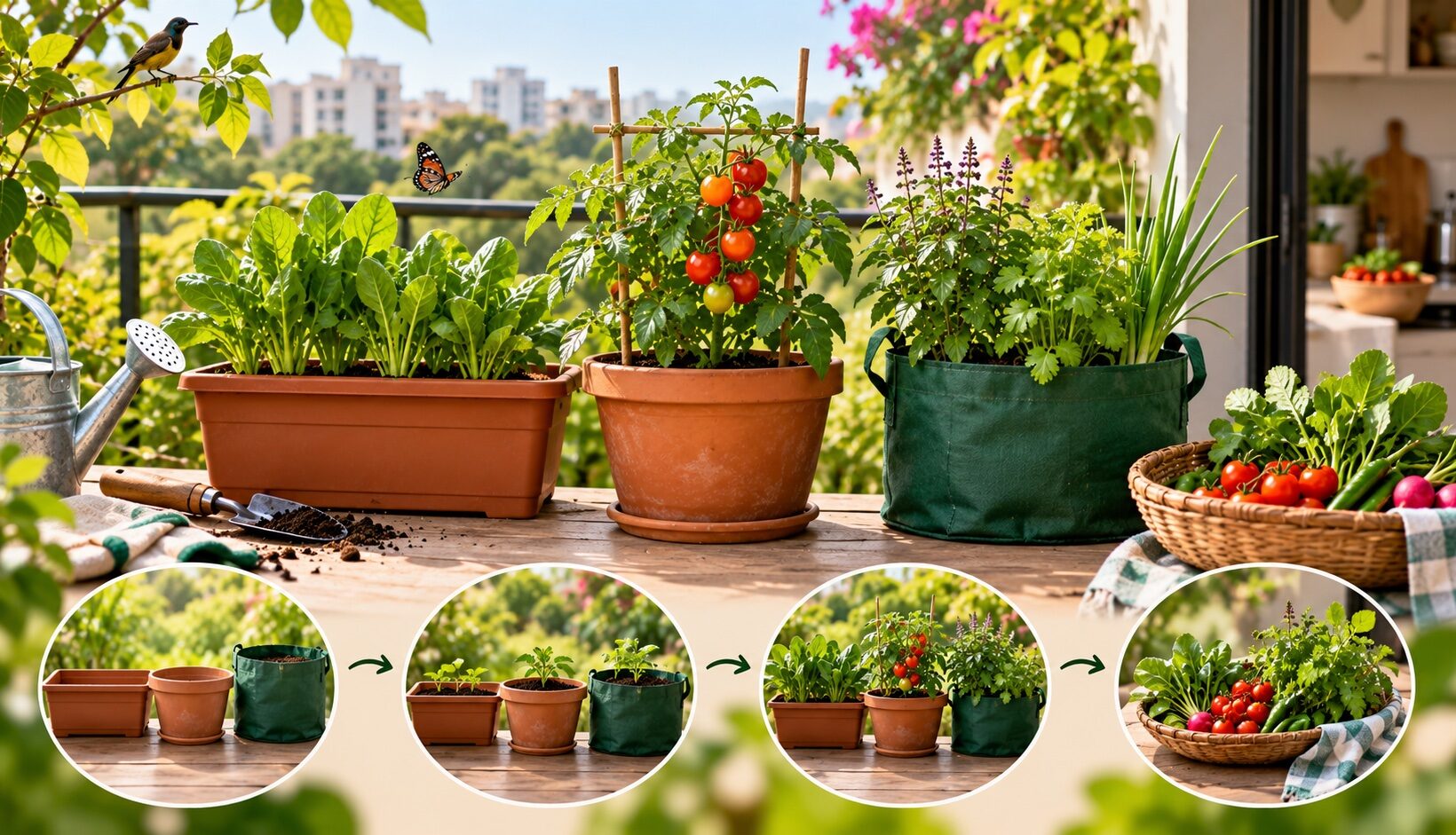
What you get: a cutting of palak, methi and coriander every week from about week five, from three containers on a sill, balcony or terrace. Total setup cost is under ₹600 if you use paint buckets.
Before you buy anything: find your light
Stand where you plan to grow and watch it across one day. Note the hours of direct sun — sunlight falling on the spot, not just brightness.
- Six hours or more — you can grow anything in this guide, plus tomato, chilli and okra.
- Four to five hours — greens, herbs, radish and spring onion. This is most Indian balconies.
- Two to three hours — coriander, mint, ajwain leaf and spring onion only. Do not attempt fruiting crops; they will grow tall, pale and never set.
- Under two hours — grow foliage, not food. A money plant and a snake plant will be happy; a tomato will not.
A south or west aspect gives the most sun in India; a north balcony gives the least. East is ideal for greens because the sun is off them by noon.
Containers
Depth matters far more than width. Any container works if water can leave it.
- Leafy greens (palak, methi, coriander) — 15 to 20 cm deep. A rectangular trough is best; you get more edge to cut from.
- Roots (radish, carrot, beetroot) — 30 cm deep, minimum, or the root forks and stops.
- Fruiting (tomato, chilli, brinjal) — one plant per 30 to 40 cm pot. Two plants in one pot halves both.
- Trees in pots (curry leaf, lemon) — 45 cm deep and wide.
Twenty-litre paint buckets are the cheapest good container in India. Drill or heat-punch four holes of about 1 cm in the base, plus four low on the sides. Cover each hole with a shard of broken pot so soil does not wash out. A container without drainage holes will kill every plant you put in it — this is the single most common reason a first attempt fails.
The potting mix
Do not fill a pot with garden soil alone. It compacts into a brick after three waterings and the roots suffocate.
Mix by volume, in a tarpaulin or on the floor:
- 2 parts garden soil or ordinary red soil
- 1 part compost or well-rotted cow manure
- 1 part coco peat (soak the brick in water first; one brick swells to about 8 litres)
- 1 handful of neem cake per bucket, mixed through — it deters soil pests
Squeeze a fistful. It should hold together and then crumble when you poke it. If it stays as a wet ball, add more coco peat; if it will not hold at all, add more soil.
Fill each container to 3 cm below the rim. That gap is what stops water running over the side.
Sowing, week by week
Best time to start: October or November across most of India — the easiest season for a beginner. February and June are the other two windows.
Week 1 — sow
- Palak: seeds 1 cm deep, 5 cm apart, in rows 10 cm apart.
- Methi: broadcast kitchen methi seed thickly across the surface, cover with half a centimetre of mix, press down gently. Do not space it out — methi is grown thick and cut whole.
- Coriander: rub the round seeds between your palms first to crack them; germination roughly doubles. Sow 1 cm deep, 3 cm apart.
Water with a mug or a rose-head can, never a full jet — a jet washes the seed into a corner. Keep the surface damp, not wet. Germination takes 4 to 7 days for palak and methi, 8 to 14 for coriander.
Week 2 to 3 — thin
Once seedlings have two proper leaves, pull out the weakest so that each palak plant has a palm-width of space. This feels wasteful and is the difference between a crop and a crowd of thin stems. Thinnings go in the salad.
Week 4 — feed
Water once with diluted compost tea: one mug of compost in a bucket of water, left overnight, strained. Repeat every fortnight thereafter.
Week 5 onward — cut
Cut the outer leaves with scissors, 2 cm above the soil, and leave the growing centre. Never uproot the plant. Palak gives four cuttings this way, coriander three. Methi is cut once, whole, at about three weeks — then re-sow that tray.
Watering — the thing most people get wrong
Push a finger 3 cm into the soil. If it comes out with soil sticking to it, do not water. Overwatering kills far more container plants in India than drought does; the symptoms look identical (drooping, yellowing), so people water again and finish the plant off.
Water in the morning. Evening watering leaves foliage wet overnight, which is how fungal problems start. In peak summer a shallow trough may need water twice a day; in winter, once every second or third day.
When something goes wrong
- Tall, pale, floppy seedlings — not enough light. Move the container; nothing else will fix it.
- Lower leaves yellowing, soil always damp — overwatering or blocked drainage. Stop watering, check the holes.
- Seedlings collapse at soil level — damping off, a fungus of wet crowded trays. Sow thinner, water in the morning only, and dust the surface with wood ash.
- Sticky curled leaf tips with small green insects — aphids. Spray a solution of 5 ml neem oil plus two drops of dish soap in 1 litre of water, on both leaf surfaces, at dusk. Repeat after five days.
- Fine webbing under leaves in hot dry weather — spider mite. Spray the underside of the leaves with plain water daily for a week; they hate humidity.
- Holes chewed overnight — snails or caterpillars. Look under the pot rims at night; hand-picking works better than anything you can buy.
- Coriander flowers and stops — it has bolted, which heat causes. Normal. Let it set seed for the kitchen and sow again in cooler weather.
What to add next
Once the first three are cutting reliably, add a deep pot with a curry leaf or a lemon, and one 30 cm pot with a chilli. Those three keep producing for years, so your weekly effort stays with the fast greens.
- Review
- Not yet reviewed by a named specialist
- प्रकाशित