
Growing in Small Spaces
Balconies, sills, stairwells and a 3-foot ledge
 admin
4 min read
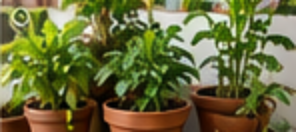
What you get: a plan for the space you actually have — measured, weight-checked and planted so that a 3 by 6 foot balcony carries about 20 containers without you having to squeeze past them.
Measure before you buy
Write down four numbers: the floor length and depth of the usable strip, the railing height, and the wall height you can reach comfortably. Most Indian balconies are between 90 and 120 cm deep, and only the outer 45 cm of that gets useful sun. Plan for the sunny strip and use the shaded inner half for foliage, storage and standing room.
Keep a 45 cm walking lane. A garden you have to step over stops being watered by about week three.
Weight — the check nobody does
Wet soil weighs roughly 1.4 kg per litre. A 20-litre bucket, watered, is about 28 kg. Ten of them along a railing is over a quarter of a tonne on one line.
- Keep heavy containers against the building wall, where the slab is strongest — never in a row along the outer edge of a cantilevered balcony.
- Use coco peat-heavy mixes and plastic or fibre pots rather than ceramic and concrete; you can halve the weight for the same volume of soil.
- Railing planters must be bolted or tied with wire through the bracket, not simply hooked. A planter that falls from the fourth floor is a serious matter.
- If you are on a rented upper floor, or the balcony is more than about 1.2 m deep with no visible support, ask a structural engineer before installing a full terrace garden.
Grow upward — the four layers
A small space gains capacity vertically, not horizontally.
- Railing line (60–90 cm): long troughs of shallow-rooted greens — palak, methi, coriander, spring onion, lettuce. This is your best-lit position; put the crops you cut weekly here.
- Floor, against the wall: the deep heavy pots — curry leaf, lemon, chilli, brinjal, a bag of potato. One deep pot per corner.
- Wall (up to 180 cm): a wire mesh or bamboo trellis carrying beans, cucumber, bottle gourd or a passion fruit. One 30 cm pot at the base feeds a vine that covers 2 square metres of wall.
- Overhead: hanging baskets of mint, ajwain leaf, trailing money plant or a strawberry, on wall hooks — never hung outside the railing over a public path.
Stacked plastic crates lined with old sacking make an excellent cheap herb tower: three crates give you nine growing positions in the footprint of one.
What to plant where the light is poor
A north-facing balcony or a stairwell landing gets bright light and almost no direct sun. That rules out every fruiting vegetable, but not gardening.
- Two to three hours of sun: coriander, mint, ajwain leaf, spring onion, lettuce, palak (thin crop), curry leaf (slow).
- Bright shade, no sun: money plant, snake plant, ZZ plant, peace lily, maidenhair fern, aglaonema, syngonium, spider plant.
- Deep shade: snake plant and money plant only, and even they will grow slowly.
Reflected light is real: painting the inner wall white, or fixing a white board behind a shelf, measurably improves growth on a dim balcony.
Watering a small space so it survives a holiday
- Group pots by thirst — daily-water troughs together, fortnightly succulents together. Mixed groups get one of the two wrong.
- Self-watering: stand troughs in a shallow tray with 2 cm of water in summer. Do not do this in the monsoon.
- Mulch every pot. A 2 cm layer of dry leaves, coco husk or even gravel cuts evaporation by roughly a third and keeps the root zone cool on a hot slab.
- Going away for a week: water thoroughly, move everything into shade, mulch heavily, and stand each pot in a tray of water. For a fortnight, a drip system from a 20-litre bottle with a pinholed cap will keep a group of five alive.
Heat, wind and rain on a high floor
- A concrete slab in May radiates heat upward and cooks roots from below. Stand pots on wooden battens, bricks or a bamboo mat — a 3 cm air gap makes a visible difference.
- Wind above the fourth floor desiccates leaves faster than sun does. A bamboo chik or a green shade net on the windward side halves the water use.
- Shade net: 50% net over the railing from April to June, removed in July. Do not leave it up through the monsoon; the plants need every hour of that weak light.
- Monsoon: move pots away from a wall that sheets water, and lift them onto bricks so they are not standing in a puddle for six weeks. Waterlogging is the main monsoon killer on a balcony.
A worked plan: 3 by 6 foot balcony, four hours of sun
- Railing: three 60 cm troughs — one palak, one methi and coriander, one spring onion and lettuce.
- Left corner: a 45 cm pot with a curry leaf.
- Right corner: a 40 cm pot with two chilli plants and a marigold at the edge.
- Wall trellis: a 30 cm pot with cluster beans or cucumber, trained up mesh.
- Hooks: two hanging baskets — mint, and ajwain leaf.
- Floor, shaded inner half: the two compost buckets, a stack of dry leaves, and a snake plant.
That is around 20 growing positions, roughly 180 kg watered, all of it against the wall or on the railing brackets, with a clear lane to stand in. It will give a household cuttings of greens weekly and herbs daily.
- Review
- Not yet reviewed by a named specialist
- Published